I may earn a commission at no extra cost to you. #ad
Free Guide to Advanced Plyometrics: Building a Savage Vertical Leap
To build a savage vertical leap, you must understand that jumping isn't just about leg strength—it's about the Rate of Force Development (RFD). You can have a 500lb squat, but if you cannot recruit those muscle fibers in 0.2 seconds (the typical ground contact time of a jump), that strength won't translate to the court or the field.
Advanced plyometrics bridge the gap between absolute strength and explosive power. We are training the nervous system to fire rapidly, utilizing the elastic properties of your tendons to propel you upward like a coiled spring.
Neurological Priming and Warm-Up
You cannot jump at 100% capacity with a cold nervous system. Traditional static stretching actually reduces power output. For advanced athletes, we use Neurological Priming. This involves low-volume, high-intensity movements that "wake up" the motor units.
- Pogo Jumps: Short, snappy jumps focusing on minimal ground contact time.
- Medicine Ball Slams: To activate the core and upper body integration.
- Box Drops (Landing Mechanics): Stepping off a box and landing "sticking" the position to prime the eccentric absorption.
The Stretch-Shortening Cycle (SSC)
The Stretch-Shortening Cycle (SSC) is the "active stretch" of a muscle followed by an immediate shortening. Think of it like a rubber band. If you stretch it and hold it, the energy dissipates. If you stretch and release it instantly, it snaps with high velocity.
Advanced plyometrics focus on shortening the Amortization Phase—the tiny fraction of a second between landing and taking off again. The faster this transition, the higher the leap.
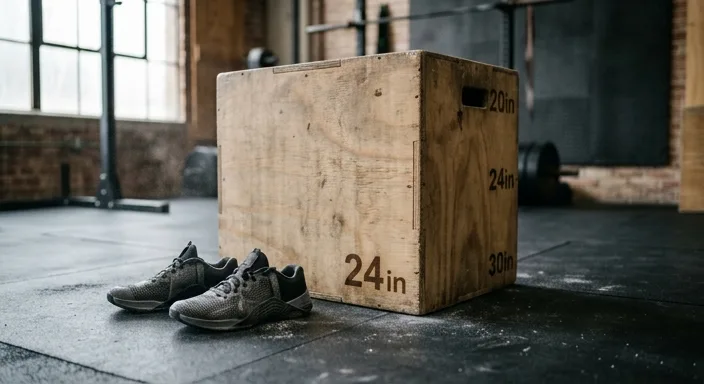
Shock Training: The Depth Jump
Popularized by Soviet scientist Yuri Verkhoshansky, Shock Training is the pinnacle of advanced plyometrics. The primary tool is the Depth Jump.
In a depth jump, you step off a box (usually 18-30 inches), hit the ground, and immediately explode upward. The impact of the landing creates a "shock" that forces the body to produce massive amounts of force to counteract gravity. This is not for beginners; your joints and tendons must be conditioned to handle 5-7x your body weight in force upon landing.
Elite Exercises for Maximum Lift
To reach elite levels, you need more than basic box jumps. Implement these variations into your routine:
- Weighted Vest Jumps: Adds 5-10% of body weight to increase force requirements without compromising mechanics.
- Seated Box Jumps: Eliminates the momentum of the eccentric phase, forcing pure concentric power from a dead stop.
- Approach Jumps: Mimicking the "penultimate step" of a dunk or volleyball spike to translate plyometric power into sport-specific movement.
- Depth to Broad Jumps: Training horizontal and vertical force translation simultaneously.
The Savage Vertical Program Structure
High-level plyometrics should never be performed in a state of fatigue. Quality always trumps quantity. A typical advanced session should look like this:
Frequency: 2 days per week (Max).
Rest: 2-3 minutes between sets to allow ATP-PC stores to replenish.
- Plyometric Prep: Pogos (2x20)
- Max Effort: Depth Jumps (4 sets of 3 reps) - Focus on height.
- Elasticity: Continuous Hurdle Hops (3 sets of 5 hurdles) - Focus on speed.
- Concentric: Seated Box Jumps (3 sets of 5 reps).
CNS Recovery and Frequency
Plyometrics are "expensive" for the Central Nervous System (CNS). While your muscles might not feel sore like they do after a heavy leg day, your nervous system can take 48-72 hours to fully recover. Signs of CNS fatigue include decreased vertical height, sluggish reaction times, and lack of "pop."
Never perform advanced plyometrics on consecutive days. Pair them with your heavy lifting days (High/Low method) to ensure you have dedicated days for total recovery.
Frequently Asked Questions
How many inches can I add to my vertical with advanced plyos?
Depending on your starting point and training age, well-structured advanced plyometrics can add 4-8 inches to a vertical leap over a 12-week cycle.
Is it better to jump with weights or without?
Both have a place. Unweighted jumps train velocity, while weighted jumps train force. For a savage leap, you need a balance of both.
Should I do plyometrics before or after lifting?
Always before. You want your nervous system to be fresh to maximize power output. Lifting should follow to build the raw strength foundation.